

My cousin Timber Wolfe, perhaps influenced by his name, reminded me recently that the great horned owls eat the bunnies, small foxes and birds that also call this place home.
“The owls are predators,” he said.
Yet he failed to lessen my romantic sentiment, even after yesterday’s related incident, as I watched a hawk send a covey of quail from our fountain to safety beneath the bushes, where they stood as still as statues for what seemed like hours.
George, who paints all night and sleeps until noon, missed the owls for years.
“Take a picture!” he said, frustrated with my failure as a nature photographer.
This summer things changed with the owls. In the first weeks none appeared; but it was foggy, and I assumed they chose another spot from which to view the morning light. After some time, however, I heard the hooo-hooo for an hour or more each morning, sometimes waking George, so that we discussed the possible reasons for this sad cry. Yet even as we scanned the water’s edge, the branches, and the roof, we couldn’t spy the source.
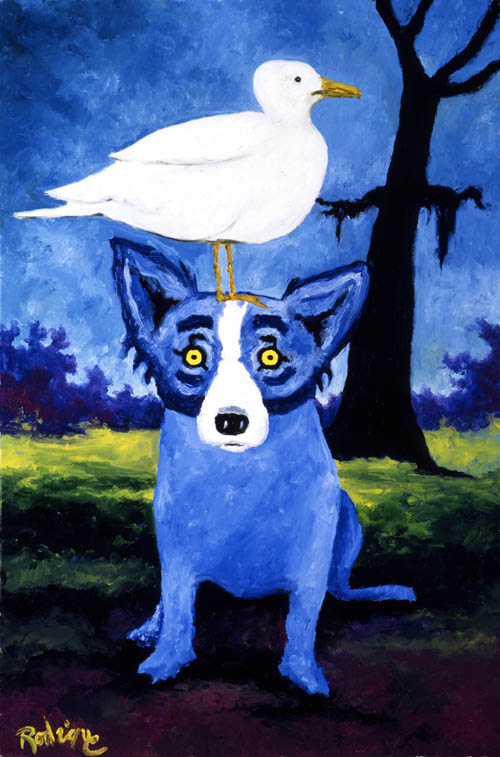
(pictured, I’m Looking for Someone Like Me, 1992 by George Rodrigue)

This week we watched a movie about muses and artists and love affairs called Bride of the Wind (2001). It was twenty years ago that a similar movie, Impromptu, reflected, in a way, the impromptu shift in my life’s course. I had returned from Vienna only three years before, and it was there that I contemplated Gustav Klimt’s Adam and Eve, a painting I visited dozens of times over many months while musing about my destiny.
(pictured, Adam and Eve, 1916 by Gustav Klimt; also see the post “Indiscretion: A Nude Addendum”)


Impromptu (1991), based on the real life love affairs and friendships of author George Sand (a woman who posed as a man so that she would be taken seriously as a writer) with composers Frederic Chopin and Franz Liszt, poet Alfred De Musset, and artist Eugene Delacroix, inspired the hopeful muse within me, as though I were twelve years old again, imagining that my knight climbed the long locks of my hair to reach my tower prison.
(pictured, Portrait of George Sand, 1838 by Eugene Delacroix)


This was also the year I took a chance and went to work for the Rodrigue Gallery of New Orleans. It was the year I met George Rodrigue, the year my life changed forever.
(pictured, Wendy and Me, 1997 by George Rodrigue)


I spent much of 1991 and 1992 reading the complete works of George Sand, as I listened to Chopin’s preludes and etudes, immersing myself in this real-life fairytale.
Similarly, I have a history with the artists in Bride of the Wind, a movie based on the true story of Alma Mahler and her love affairs with composer Gustav Mahler, architect Walter Gropius, and artist Oskar Kokoschka. She lived in that same inspired world, the one that transported me as a college student (through Adam and Eve) to Fin de Siécle Vienna.
“How was I twisted magically, since from a hazy world, prospecting her, a small white bird summoned me, ALLOS, ALLOS, whom I never came across. Since in an instant swiftly she transformed herself into my being, like a back door. Suffer, ears, Strive, you eyes, to spot her! I into the indigent summer night, which faded and cries from a rift in the earth.”*
In 1988 my Viennese professor teaching Austrian Art and Architecture claimed to have had a long-running affair with Kokoschka. During her classes I struggled to retain the academic lessons while daydreaming about the romantic ones. It was this notion of ‘the lover of a great artist’ that intrigued me. What on earth must it feel like to be a muse, to affect a creative soul in such a way that their personal expression involves you and remains as such forever?
(pictured, The Bride of the Wind, 1914, a self-portrait with Alma Mahler by Oskar Kokoschka)


I leave that question unanswered here, not because I don’t know the answer, but because it confounds me, and I am without the words.
This morning George came into the bedroom from his studio after painting all night. We stood at the window and watched the sunrise.
“There’s only one owl,” I whispered.
“Maybe they split up,” he said.
But we both knew better.


Wendy
*From the poem, Allos Maker (an anagram from the names Alma and Oskar, meaning “Happiness is otherwise”), by Oskar Kokoschka, 1913
For a related post, see “Nature Girl (The Art of Modeling)”
Coming this weekend: “The Cajun Bride of Oak Alley”