“Be truthful one would say, and the result is bound to be amazingly interesting.”*
From day one, from his return to Louisiana from art school in Los Angeles in the late 1960s, George Rodrigue wanted one thing: to make a living as an artist.
However, he never imagined that selling his art would be up to him. He assumed his paintings would attract agents and established galleries. They would sell his work, and he would paint. Yet at that time there were no galleries in Lafayette, Louisiana, and with the exception of the Reilly Gallery in New Orleans, which showed his work for a few months in the early 1970s, there was not a gallery anywhere that would display George’s dark, repetitive landscapes. (pictured, Duperier Oaks, 1969, 30×40, oil on canvas)
He knocked on doors for months with hopes of representation and finally gave up, placing an ad in the back of Southern Living Magazine and Acadiana Profile, using his home address and phone number.
To his surprise the response to the tiny black-and-white advertisement was immediate. Yet people were shocked to find a young man in his twenties behind these seemingly antique works.
George tells a story of one afternoon when, as he mowed the lawn, a car pulled up to his house on Duclos Street in Lafayette, Louisiana, and a man called from the window,
“Son, is your daddy home?”
“My daddy’s dead, Sir.”
“Then who paints the pictures?”
(pictured, Disco on Duclos, a self-portrait from 1993, recalling his first gallery)
As long as he can remember, George Rodrigue fought to be taken seriously as an artist. Within a year after his return from art school in 1967 he supported his family with his original ideas on canvas, bringing in $100 a month at first, with sales of two to three paintings from the front door of his house.
In the mid 1970s, after adding Cajuns to his paintings, he hit the road, selling from the trunk of his car with great success in Houston, Dallas, Jackson, Birmingham, Shreveport and other cities, finding a more receptive audience for his regional subjects, ironically, the further he strayed from home. (pictured, The Mamou Riding Academy, 1971, 36×54, oil on canvas)
He raised his prices, selling canvases for $3000 to $5000 from his makeshift gallery, the trunk of a bumped-up Lincoln Mark V, because still, despite hundreds of paintings, successful sales, and five years after his return from a prestigious art school, no agent wanted him, and no gallery carried his paintings.
Facing reality and hoping for less time on the road, George rented a space on Pinhook Road in Lafayette, Louisiana. He sold his pictures and painted his canvases with little interruption, one or two visitors a week, eating a hamburger at the place across the street each day, while eying his unlocked front door. (That same lunch spot is the home of Jolie’s Louisiana Bistro, George’s newest restaurant, where he sits today and stares across Pinhook Road at his history.)
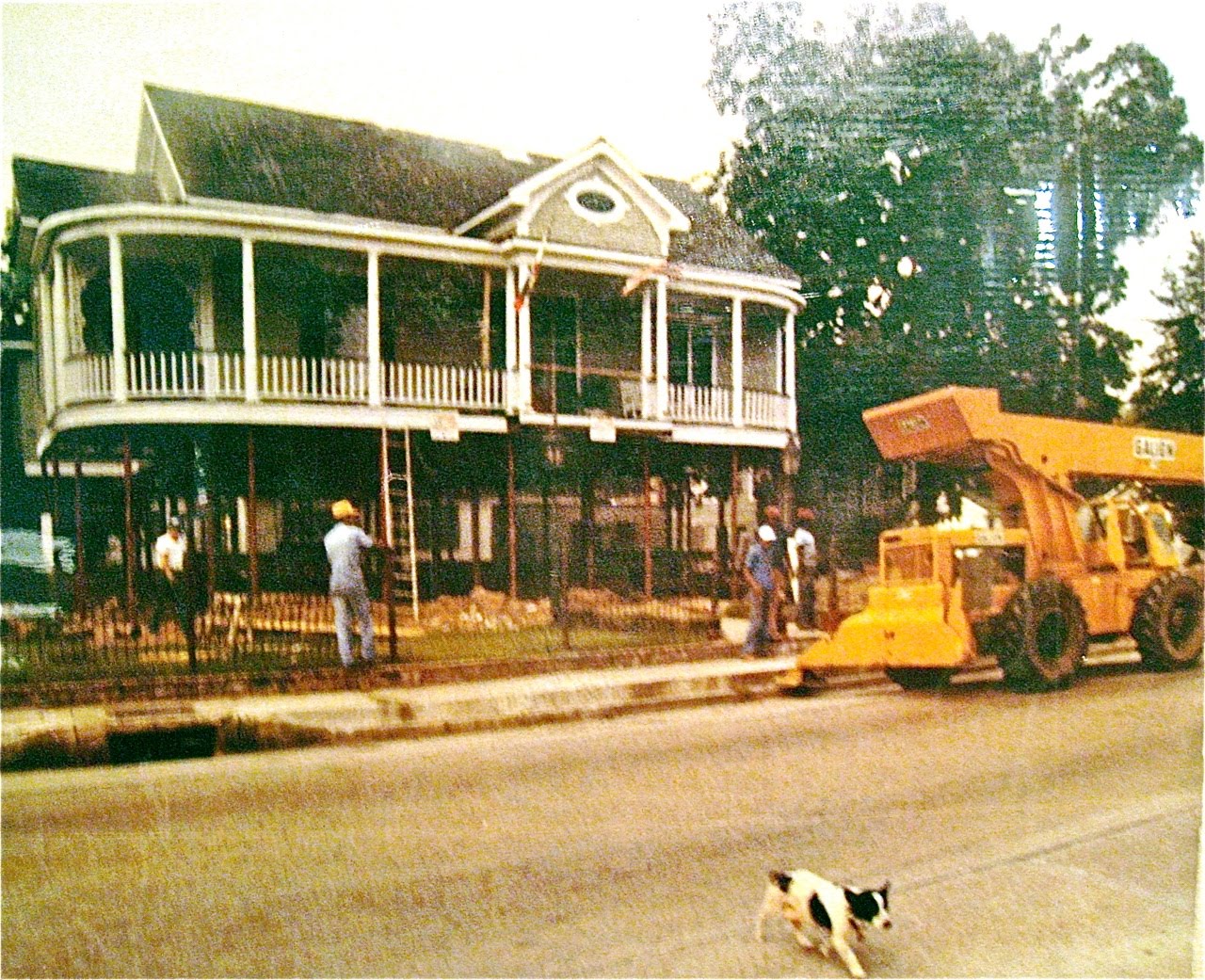
From there he moved to Jefferson Street, raising his house and building a gallery underneath, abandoning any hope of outside representation for his work. This is where George’s sons grew up, where his dog Tiffany lived, where he painted hundreds of paintings of Cajun folk life, and where most of his Cajun painting fans (unless they ran into him on the road) came to know his work.
…notice Tiffany running across the road during construction…
At last, in 1989, things changed. A local doctor and his brother, a wanna-be agent, opened a gallery at 721 Royal Street in the French Quarter spotlighting the art of George Rodrigue. For nine years this agent managed George’s career from a rented space and called it The Rodrigue Gallery of New Orleans (pictured below, May 2, 2010).
Even after George bought him out in 1998, we continued selling the Blue Dog and Cajun paintings from this rented location, a small square room badly in need of repairs and an updated design. Comfortable as his own agent and now routinely declining outside representation, George still hoped for a gallery of his own.
In charge of his career once again, the change was immediate. George painted to please himself, as opposed to an audience or agent. When he did paint for others, it was exciting projects of his choosing, such as Neiman Marcus, the Chicago Cow Parade, and Xerox. This self-representation worked in his favor. He pondered both in his head and on his canvas questions of ‘style’ and ‘meaning,’* with relief and without fear of criticism.
And yet he still wanted a gallery of his own, something unrented, available for his renovations and, in the end, reflective of his contemporary vision.
So did I: a woman, a wife, an insecure accomplice writing about her man, her husband, the breadwinner, the confident and great artist, her supportive and occasionally convincing ‘I-wouldn’t-be-where-I-am-without-you’ partner in life.
And so in 2009 we bought a building, a two hundred year-old brick structure across from our old rental space and adjacent to St. Louis Cathedral at 730 Royal Street in the New Orleans French Quarter. George and his son Jacques spent nine months on renovations, and in April 2010 George Rodrigue opened a gallery of his own.
In a strange irony probably marked by no one but me, it is his first gallery (rented or otherwise) in twenty years that, to a great deal, excludes me. He of course denies this,
“But you’re my partner! This was construction, Wendy, and you know that’s not your thing.”
And then, (and I’m still assessing the motive behind this adulation),
“You are doing something far more important with your blog. You’re setting the story straight. You are my archivist. That’s where I need you.”
“I thought how unpleasant it is to be locked out; and I thought how it is worse perhaps to be locked in; and, thinking of the safety and prosperity of the one sex and of the poverty and insecurity of the other and of the effect of tradition and of the lack of tradition upon the mind of a writer, I thought at last that it was time to roll up the crumpled skin of the day, with its arguments and its impressions and its anger and its laughter, and cast it into the hedge.”*
And so I found some confidence, a direction, all within these coincidental events (a new gallery for George, a blog for me). I have an audience, and yet I have no illusions. As I write these stories and listen to the questions of dearest and concerned friends, I wonder,
“Does it lessen my own accomplishment because I write about my husband?”
Or do I owe it to womankind and to my mother (the older generation, who did not have thirteen children, but who raised me well) and to the children I forfeited for George (although he didn’t ask), nay, for me, and to my husband, who supports me, praises me, encourages me, who gives me credit in public and in private, who takes me seriously as a business partner, as a friend, an equal worthy of my opinions on creation, on the meaning of life, on where to spend the holidays, on what to have for dinner, on how to hang the gallery, on his art? Or is it because,
“Women have served all these centuries as looking-glasses possessing the magic and delicious power of reflecting the figure of man at twice its natural size. Without that power probably the earth would still be swamp and jungle.”*
It is because of George that I keep writing…not because I must exaggerate his story, and not even because I must tell his story (in fact there are many who could relay far better, and with any luck this blog will attract just such a biographer), nor because his ego requires it, but rather because he believes in me, because he encourages this blog of my own.
So do you get it? Have you figured out my deception in this story? My thievery? My homage? The echo, albeit weakly interpreted, of a brilliant essay?
“The best course, unless the whole talk was to be distorted, was to expose what was in my mind to the air, when with good luck it would fade and crumble like the head of the dead king when they opened the coffin at Windsor.”*
George Rodrigue has a gallery of his own, just one block from the Reilly Gallery, the location of his first show, and the only gallery that ever took a chance on him, now forty years ago.
He has the money and owns the space, to wield as he will, to display his creations. We will see things from him in the coming years the likes of which most viewers never knew him capable:
“Hesitate or fumble and you are done for. Think only of the jump…”*
And as for me, as much for George as for myself, like V.W. I choose to defy the great Alexander Pope (“Most women have no character at all”), and yet I happily define my accomplishments by my husband’s. You see, I believe that Virginia Woolf and George Rodrigue are correct:
“So long as [I] write (paint) what [I] wish to write (paint), that is all that matters.”*
Wendy
*Unless otherwise noted, all quotes in this post are from A Room of One’s Own by Virginia Woolf, published 1929
For a virtual tour of the new Rodrigue Studio, visit here.